Johns Hopkins UniversityEst. 1876

America’s First Research University

Back to Results
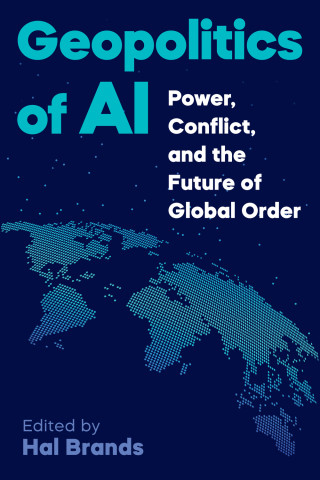
Cover of "Geopolitics of AI: Power, Conflict, and the Future of Global Order" edited by Hal Brands, featuring a digital dotted world map on a dark blue background.
Preorder
Cover of "Geopolitics of AI: Power, Conflict, and the Future of Global Order" edited by Hal Brands, featuring a digital dotted world map on a dark blue background.
Share this Title:

Geopolitics of AI

Power, Conflict, and the Future of Global Order 

edited by Hal Brands

Publication Date
Binding Type

Artificial intelligence in an age of rivalry, risk, and power.

Artificial intelligence (AI) is emerging and evolving amid intense global competition. Geopolitics of AI examines how breakthroughs in AI intersect with great-power rivalry, military competition, economic statecraft, and competing models of governance—and how those dynamics will shape the development and use of AI itself.

Edited by Hal Brands, this volume brings together leading scholars and policy analysts to address AI's strategic implications. Contributors examine how AI may alter military operations, economic productivity...

Artificial intelligence in an age of rivalry, risk, and power.

Artificial intelligence (AI) is emerging and evolving amid intense global competition. Geopolitics of AI examines how breakthroughs in AI intersect with great-power rivalry, military competition, economic statecraft, and competing models of governance—and how those dynamics will shape the development and use of AI itself.

Edited by Hal Brands, this volume brings together leading scholars and policy analysts to address AI's strategic implications. Contributors examine how AI may alter military operations, economic productivity, alliance structures, and deterrence, while also creating new challenges of instability, escalation, and misuse. The book also considers how geopolitical competition will influence technological innovation in the years ahead. Rivalries among major powers will shape research priorities, regulatory approaches, and international norms and will determine whether AI becomes a source of cooperation, coercion, or conflict. These pressures raise urgent questions about governance, control, and the balance between innovation and restraint.

Geopolitics of AI offers a timely, wide-angle perspective on one of the defining challenges of contemporary international politics. It will be of interest to scholars and students of international relations and security studies, as well as policymakers, analysts, and readers seeking to understand how emerging technologies are reshaping global order.

Reviews

Reviews

Artificial intelligence seems ubiquitous these days, as are predictions about its potential impact on economics, warfare, and possibly human survival. But this volume, curated by historian Hal Brands, offers the most comprehensive evaluation to date of the possible reordering of geopolitics that AI may bring in its wake. It is essential reading to understand today's headlines as well as tomorrow's.

A broad ranging exploration of the complex interaction between the AI revolution and grand strategy. An all-star line-up of cutting edge scholars and practitioners provides indispensable insights into how AI may upend settled assumptions about global security and prosperity; and offers policymakers and the public deeply informed advice on how to understand and navigate the highly unpredictable world we are now entering.

About

Book Details

Release Date
Publication Date
Status
Preorder
Trim Size
6
x
9
Pages
344
ISBN
9781421455822
Table of Contents

Table of Contents
Introduction: The Geopolitics of AI, by Hal Brands
AI and the Balance of Power
1. Strategic Autonomy in the Age of Artificial Intelligence, by Salman Ahmed and Matan Chorev
2. Who Will

Table of Contents
Introduction: The Geopolitics of AI, by Hal Brands
AI and the Balance of Power
1. Strategic Autonomy in the Age of Artificial Intelligence, by Salman Ahmed and Matan Chorev
2. Who Will Be AI's Economic Beneficiaries? A Critical Question for Global Balance of Power, by Rebecca Patterson
3. Artificial Intelligence, First-Mover Advantage, and the Balance of Power, by Michael Horowitz
4. AI, Demographics, and the Rise and Fall of Great Powers, by Michael Beckley
5. AI and Export Controls, by Ben Buchanan
Military Power and the Future of Conflict
6. AI and the Offense-Defense Balance in Cyberspace, by Michael Sulmeyer
7. AI, Command, and the Limits of Military Advantage, by Sarah Kreps
8. AI and War: Automating Escalation?, by Jacquelyn Schneider
9. AI and the New Fog of War, by Lawrence Freedman
State Power and Non-State Actors
10. AI Firms and Geopolitics, by Adam Segal
11. Non-State Actors in the Era of Advanced AI, by Dean Ball
Strategy-Making and Strategic Interaction
12. AI and the Making of Grand Strategy, by Peter Feaver
13. AI as Strategist: Four Hypothesis on the Nature of Agentic Strategy, by Michael J. Mazarr
Uncertain Futures and Policy Imperatives
14. The Challenge of Policymaking in the Age of AI Futures, by Seth Center
15. The AGI Moment: Strategies and Recommendations for an Uncertain Future, by Paul Scharre
16. Machines and Order, by Jim Baker
17. AI and the new clash of civilizations?, by Mark Leonard
18. Seeking Stability in the Age of AGI, by Hal Brands

Author Bio
Featured Contributor

Hal Brands

Hal Brands is the Henry A. Kissinger Distinguished Professor of Global Affairs at the Johns Hopkins School of Advanced International Studies (SAIS) and a scholar at the American Enterprise Institute. A columnist for Bloomberg Opinion, he is also the author or editor of several books, including The New Makers of Modern Strategy: From the Ancient World to the Digital Age, The Twilight Struggle: What...