Johns Hopkins UniversityEst. 1876

America’s First Research University

Back to Results
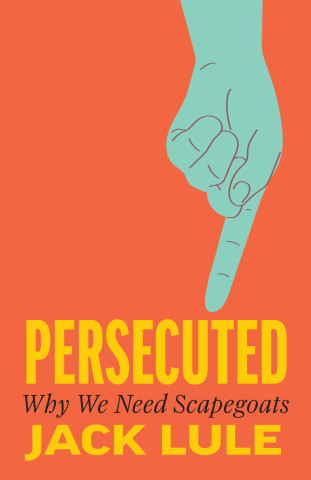
Cover of "Persecuted: Why We Need Scapegoats" by Jack Lule, featuring an orange background with a seafoam green hand pointing down to bold yellow title text.
Preorder
Cover of "Persecuted: Why We Need Scapegoats" by Jack Lule, featuring an orange background with a seafoam green hand pointing down to bold yellow title text.
Share this Title:

Persecuted

Why We Need Scapegoats

Jack Lule

Publication Date
Binding Type

The making of the modern scapegoat.

Who gets blamed when societies feel under threat and why? In Persecuted, journalism scholar Jack Lule examines the deep roots of scapegoating as essential to human society. Scapegoating helps explain how and why people unite, shaping the ways groups define belonging, exclusion, and collective identity.

Drawing on the work of Kenneth Burke and René Girard, Lule argues that scapegoating is not a social malfunction but a core mechanism through which communities are formed. Nations rely on scapegoating to draw boundaries between "us" and "them." What makes the...

The making of the modern scapegoat.

Who gets blamed when societies feel under threat and why? In Persecuted, journalism scholar Jack Lule examines the deep roots of scapegoating as essential to human society. Scapegoating helps explain how and why people unite, shaping the ways groups define belonging, exclusion, and collective identity.

Drawing on the work of Kenneth Burke and René Girard, Lule argues that scapegoating is not a social malfunction but a core mechanism through which communities are formed. Nations rely on scapegoating to draw boundaries between "us" and "them." What makes the modern era especially volatile, he contends, is the role of media—from early messengers and newspapers to contemporary social platforms—in manufacturing crises, amplifying accusations, identifying targets, and accelerating cycles of blame. Moving fluidly across history, theory, and contemporary politics, the book shows how media systems have increased the reach, speed, and intensity of scapegoating, often transforming local resentments into global networks of hate and hostility. Lule presents a sober analysis of how scapegoating persists precisely because it feels natural, justified, and invisible to those participating in it.

Persecuted is a concise, unsettling exploration of a process that underlies nationalism, moral panics, and political polarization. Its hope—tentative but urgent—is that recognizing the recurring power of scapegoating may help readers identify it in real time and resist its most destructive consequences.

Reviews

Reviews

Jack Lule does not deny the impossibility of ending scapegoating, especially now, when it's compounded by heightened nationalism and social media. Still, Persecuted's calm, sober prose, global examples, and humane sensibility may provoke people to recognize and challenge this awful human habit of persecuting groups for problems they didn't cause.

Lule's public intelligence is phenomenal. References to Buber and Girard are necessary in the history of ideas, but the book's theory in social philosophy is deeper on systemic structures and superior in comprehensive range. The argumentative flow on national dynamics is developed with coherence and unity. This is a literary masterpiece on communal communication in human life.

Jack Lule's Persecuted confronts uncomfortable questions. Why, despite our knowledge and reason, do communities still form themselves in opposition to their perceived enemies? Why do people so often make neighbors by excluding strangers? Lule's detailed and accessible primer on the persistent threat of scapegoating appears at a vital moment.

About

Book Details

Release Date
Publication Date
Status
Preorder
Trim Size
5.5
x
8.5
Pages
248
ISBN
9781421455853
Table of Contents

Table of Contents
1. On Scapegoating: An Introduction
2. Study of the Scapegoat: "The Lucky Goat"
3. Kenneth Burke: The Scapegoat Arises from Language
4. René Girard: The Scapegoat Arises from Mimesis
5

Table of Contents
1. On Scapegoating: An Introduction
2. Study of the Scapegoat: "The Lucky Goat"
3. Kenneth Burke: The Scapegoat Arises from Language
4. René Girard: The Scapegoat Arises from Mimesis
5. Burke and Girard: "The Club of Scapegoating"
6. The Nation: Origins of Nationalism
7. The Nation: Nationalism and the Other
8. The Nation: Nationalism and Racism
9. The Media and the Nation: Creating Whose Imagined Community?
10. The Media and the Nation: Creating Whose Imagined Community?
11. The Media: Merchants of Hate
12. The Media: Networks of Hate
13. The Media and the Scapegoat: "Using Up" the Scapegoat
14. "Using Up" the Scapegoat: Imagine That

Author Bio
Featured Contributor

Jack Lule

Jack Lule is professor emeritus of journalism at Lehigh University. He is the author of Globalization and Media: Global Village of Babel; Understanding Media and Culture: An Introduction to Mass Communication; and Daily News, Eternal Stories: The Mythological Role of Journalism.