Johns Hopkins UniversityEst. 1876

America’s First Research University

Back to Results
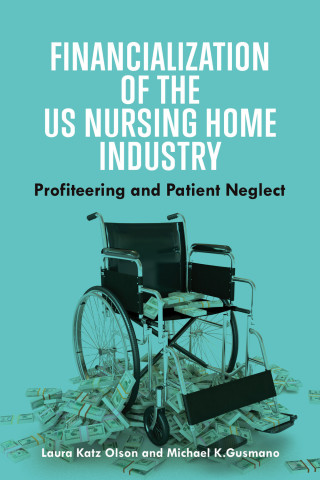
Cover of "Financialization of the US Nursing Home Industry" by Laura Katz Olson and Michael K. Gusmano, featuring a wheelchair atop piles of cash on a teal background.
Preorder
Cover of "Financialization of the US Nursing Home Industry" by Laura Katz Olson and Michael K. Gusmano, featuring a wheelchair atop piles of cash on a teal background.
Share this Title:

Financialization of the US Nursing Home Industry

Profiteering and Patient Neglect

Laura Katz Olson and Michael K. Gusmano

Publication Date

How financial profiteering has reshaped long-term care and jeopardized the well-being of nursing home residents.

Nursing homes care for some of the nation's most vulnerable citizens. They are also increasingly controlled by financial actors whose priorities lie far from the bedside. In Financialization of the US Nursing Home Industry, Laura Katz Olson and Michael K. Gusmano examine how for-profit companies—and increasingly private equity firms and real estate investment trusts (REITs) with complex ownership structures—have transformed long-term care into a vehicle for profit extraction.

Drawing...

How financial profiteering has reshaped long-term care and jeopardized the well-being of nursing home residents.

Nursing homes care for some of the nation's most vulnerable citizens. They are also increasingly controlled by financial actors whose priorities lie far from the bedside. In Financialization of the US Nursing Home Industry, Laura Katz Olson and Michael K. Gusmano examine how for-profit companies—and increasingly private equity firms and real estate investment trusts (REITs) with complex ownership structures—have transformed long-term care into a vehicle for profit extraction.

Drawing on extensive case studies of major chains and mid-sized operators, the authors trace the industry's consolidation over decades and document how financial engineering—asset stripping, related-party transactions, real estate manipulation, and deliberate labor cost cutting—has reshaped nursing home operations. Chronic understaffing, declining care quality, opaque ownership arrangements, and repeated bankruptcies plague a system designed to maximize returns. The book places these developments in historical and policy context, showing how federal and state government policies enabled substandard conditions even as public funds—primarily Medicare and Medicaid—now supply roughly three-quarters of industry revenue. The COVID-19 pandemic exposed long-standing systemic obstacles to decent care, revealing how financial priorities can have deadly consequences for residents and frontline caregivers alike.

This essential book offers scholars, policymakers, students, and advocates a comprehensive account of how the nursing home industry works—or doesn't work—and why meaningful reform will require structural change. Care for powerless older people, the authors argue, must be treated as a public responsibility rather than a private investment strategy.

About

Book Details

Release Date
Publication Date
Status
Preorder
Trim Size
6
x
9
Pages
224
ISBN
9781421456133
Table of Contents

Introduction
Chapter 1. Understaffed and Undervalued
Chapter 2. History of Nursing Homes in the US
Chapter 3. The Rise of Private Equity in the Twenty-First Century
Chapter 4. The Largest Publicly Traded

Introduction
Chapter 1. Understaffed and Undervalued
Chapter 2. History of Nursing Homes in the US
Chapter 3. The Rise of Private Equity in the Twenty-First Century
Chapter 4. The Largest Publicly Traded Chains of the 1990s: Case Studies
Chapter 5. Nursing Homes as Personal ATMs: Case Studies
Chapter 6. The Latest Private Equity Exploiters in the Twenty-First Century: Case Studies
Conclusion. Warehousing the Vulnerable, Structural Failures, and the Profit Motive in US Nursing Homes
Notes
Index

Author Bios
Featured Contributor

Michael K. Gusmano, Ph.D.

Michael K. Gusmano, PhD, is the Associate Dean of Academic Affairs, Iacocca Chair, and Professor of Health Policy at the College of Health at Lehigh University. He is a coauthor of Health Care in World Cities: New York, Paris, and London.