Johns Hopkins UniversityEst. 1876

America’s First Research University

Back to Results
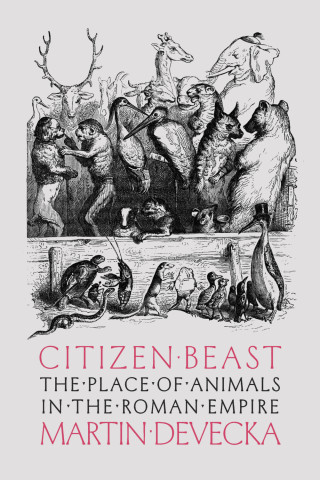
Cover of "Citizen Beast: The Place of Animals in the Roman Empire" by Martin Devecka, featuring black-and-white engraving of assorted animals gathered like a crowd.
Preorder
Cover of "Citizen Beast: The Place of Animals in the Roman Empire" by Martin Devecka, featuring black-and-white engraving of assorted animals gathered like a crowd.
Share this Title:

Citizen Beast

The Place of Animals in the Roman Empire

Martin Devecka

Publication Date

Animals, power, and belonging in the Roman Empire.

Animals were everywhere in the Roman world: in labor, ritual, entertainment, warfare, and luxury. In Citizen Beast, Martin Devecka argues that they were not merely background figures but central participants in the formation of empire. He examines how animals came to belong to Rome and how their incorporation mirrored the processes that shaped human citizenship, subjection, and exclusion.

Birds, mice, elephants, bears, pigs, donkeys, eels, and oysters serve as case studies for understanding how imperial power organized life itself. Through these...

Animals, power, and belonging in the Roman Empire.

Animals were everywhere in the Roman world: in labor, ritual, entertainment, warfare, and luxury. In Citizen Beast, Martin Devecka argues that they were not merely background figures but central participants in the formation of empire. He examines how animals came to belong to Rome and how their incorporation mirrored the processes that shaped human citizenship, subjection, and exclusion.

Birds, mice, elephants, bears, pigs, donkeys, eels, and oysters serve as case studies for understanding how imperial power organized life itself. Through these examples, Citizen Beast reveals an empire that governed humans and animals together, treating both of them as economic resources and symbolic instruments. Roman writers often understood animals as intentional beings whose cooperation—or resistance—mattered. Devecka shows how these ideas helped structure legal practices, religious rituals, systems of punishment, and regimes of extraction. Animals helped enforce violence, stabilize hierarchy, and produce elite distinction, while also exposing the limits of imperial control.

By treating the Roman Empire as a multispecies world, Citizen Beast reframes familiar histories of power, agency, and governance. The result is a striking account of how empire functioned by managing living beings—and why animals must be understood as historical actors in their own right.

Reviews

Reviews

The learned and charming Martin Devecka returns, decentering human beings to show how animals made the Roman Empire. Always fascinated by offbeat texts that are rarely discussed at all, Devecka listens to oxen and eels, beavers and oysters, pigs, bears, elephants, ravens, and mice for stories of wonder and cruelty.

Devecka's book brilliantly reveals how the social and biological machinery of empire was informed by animals and their parts. His detailed examination of the animal in Roman culture is imaginative, urgent, and wide-ranging, and made me reconsider my own relations with animals in the world.

An exceptionally vivid, fresh, and imaginative book unfolds a provocative thesis. Roman natural history teems with bizarre stories about animals which, Devecka explains, mirror the problematic social arrangements of an imperial slave-owning society by pairing them with apparently 'natural' (and therefor desirable) arrangements in other species. A complex synthesis, lucidly explained. Outstanding.

About

Book Details

Release Date
Publication Date
Status
Preorder
Trim Size
6
x
9
Pages
256
ISBN
9781421455181
Illustration Description
4 b&w photos, 1 line drawing
Table of Contents

Table of Contents
Acknowledgements
Introduction
1. The Day of the Raven
2. A Mouse in the House
3. The Elephant's Religion
4. In the Mouth of the Bear
5. Pig Meat, People Meat
6. Oxen, our Allies
7. Beaver

Table of Contents
Acknowledgements
Introduction
1. The Day of the Raven
2. A Mouse in the House
3. The Elephant's Religion
4. In the Mouth of the Bear
5. Pig Meat, People Meat
6. Oxen, our Allies
7. Beaver Parts Unknown
8. Swimming With Eels
9. Pearls and Peoples
Conclusion
Notes
Bibliography

Author Bio
Featured Contributor

Martin Devecka

Martin Devecka is an associate professor of classical studies at the University of California, Santa Cruz. He is the author of Broken Cities: The Historical Sociology of Ruins.