Johns Hopkins UniversityEst. 1876

America’s First Research University

Back to Results
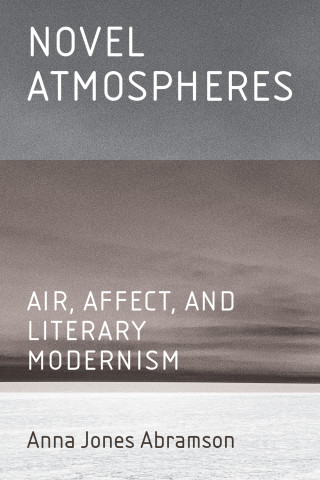
Cover of "Novel Atmospheres: Air, Affect, and Literary Modernism" by Anna Jones Abramson, featuring a muted gray seascape in horizontal minimalist color bands of sky, clouds, and water.
Preorder
Cover of "Novel Atmospheres: Air, Affect, and Literary Modernism" by Anna Jones Abramson, featuring a muted gray seascape in horizontal minimalist color bands of sky, clouds, and water.
Share this Title:

Novel Atmospheres

Air, Affect, and Literary Modernism

Anna Jones Abramson

Publication Date
Binding Type

How modernist novels learned to think through air, mood, and environment.

Modernist literature is often associated with interiority and psychological depth. Novel Atmospheres turns this account inside out, asking readers to look up and out into the air. Anna Jones Abramson shows that in the twentieth century, dramatic changes in the air changed the novel itself.

In the first three decades of the twentieth century, a series of technological innovations transformed the relationship between humans and the atmosphere: poison gas, airplanes, air conditioning, radio waves, and air raids made...

How modernist novels learned to think through air, mood, and environment.

Modernist literature is often associated with interiority and psychological depth. Novel Atmospheres turns this account inside out, asking readers to look up and out into the air. Anna Jones Abramson shows that in the twentieth century, dramatic changes in the air changed the novel itself.

In the first three decades of the twentieth century, a series of technological innovations transformed the relationship between humans and the atmosphere: poison gas, airplanes, air conditioning, radio waves, and air raids made atmosphere palpable and sometimes lethal in entirely new ways while innovations in physics and weather forecasting transformed the legibility of the sky. At the same time, modernist writers seized on the aesthetic sense of atmosphere as they experimented with formal strategies for building a new kind of novel. Abramson links literary form to atmosphere in a way that has never been done before: what might previously have seemed like modernism's vague impressionist blurs become, in this account, deliberate atmospheric designs. Focusing on formal and stylistic features such as frame narratives, free indirect discourse, and temporal structure, Novel Atmospheres makes the case that reinventing narrative form was itself an atmospheric practice.

Abramson tracks fog, heat waves, poison gas, forecasts, and miasma across the works of Joseph Conrad, Virginia Woolf, Mulk Raj Anand, and Edmund Blunden. The book argues for a new interdisciplinary approach to atmosphere located at the crossroads of affect and environment. Spanning public health, (post)colonial history, affect theory, meteorology, climate science, cultural studies and history, environmental studies, and narrative theory, Novel Atmospheres considers the political, racial, and cultural dimensions of what it means to share air, weaponize air, or mount forms of atmospheric resistance. This focus on our common air has wide-ranging implications for the urgent environmental and political questions surrounding atmosphere and climate today.

Reviews

Reviews

'Something happened': what? In Novel Atmospheres, Abramson brilliantly shifts into focus much that has been left vague in conventional accounts of modernism and reveals how fruitfully affective and environmental criticism can reshape one another. Modernist subjectivity, it turns out, is in the air—and 'even the air has a history.'

Henry James's classic exaltation of the mind's power to 'convert the very pulses of the air into revelations' captures both the interest and the achievement of this extraordinary book. In Novel Atmospheres, exquisite environmental attunement affords a revelatory new approach to literary interpretation, a really breathtaking new view of modernist fiction.

It's all there in the plural: Abramson discloses the staggering range and variety of atmospheres that mingle in the modernist novel. A meteorology of moods, a polemology of weather, a barometry of anticolonial rage—these are just a few of the currents that swirl through this absorbing book.

About

Book Details

Release Date
Publication Date
Status
Preorder
Trim Size
6
x
9
Pages
296
ISBN
9781421454993
Illustration Description
2 b&w illus.
Table of Contents

Acknowledgments
Introduction
Part I: Air Space
1. Fog
2. Heat Wave
Part II: Air Force
3. Poison Gas
4. Bad Air
Part III: Air Time
5. Forecast
Conclusion: Time Passes, Climate Changes
Notes
Bibliography
Index

Author Bio