Johns Hopkins UniversityEst. 1876
America’s First Research University
Now Browsing:
Navigating Higher Ed After the Peak: The Next Era of Education
For nearly eight decades, American higher education has been synonymous with growth—more students, more campuses, more research, more global influence. But what happens when an enterprise built on expansion reaches its natural limits?
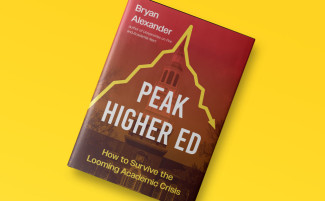
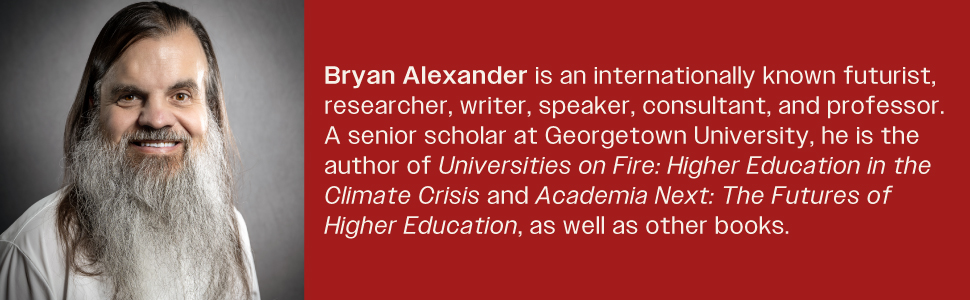
In his new book Peak Higher Ed: How to Survive the Looming Academic Crisis, noted futurist Bryan Alexander argues that we are already living in the era after the peak. Enrollment has topped out, the number of campuses is shrinking, public trust is wavering, and new pressures—technological, demographic, political, ecological—are reshaping what colleges and universities can be. Using scenario modeling and conversations with institutional leaders through his Future Trends Forum, Alexander offers a rare combination of sober assessment and actionable imagination.
Rather than lamenting change, Peak Higher Ed helps readers see the landscape ahead with clarity and begin planning for what’s next.
Alexander first introduced the idea of “peak higher ed” in 2013, when national student enrollment dipped for the first time in decades. At the time, it looked like statistical noise. Instead, it marked the start of a long, uneven decline—one that continued through the 2020s even before the COVID-19 pandemic accelerated every existing stress point.
The data, as he documents, are stark:
National enrollment peaked in 2011 at more than 18 million students and fell every year for a decade.
The total number of colleges and universities has dropped sharply, especially among small private and community colleges.
Rising costs, rising discount rates, political scrutiny, and public skepticism combine to pressure institutions from all sides.
This major structural shift invites a fundamentally different mindset.
How Did We Get Here?
Peak Higher Ed traces the forces driving higher education down its current slope:
Demographics and the enrollment cliff
Shrinking birth rates and changing migration patterns mean there will simply be fewer traditional-aged students in the coming decades.
Economic and political pressures
Decades of declining state support, rising costs, and intensifying partisan scrutiny have eroded the “college for all” consensus that once defined American life.
Technological disruption—especially AI
Artificial intelligence has the potential to upend academic labor, reshape the curriculum, and even call into question the value proposition of a degree.
Climate-driven instability
The climate crisis affects everything from campus operations to research priorities to community relations. Some campuses may struggle to operate safely or sustainably in coming decades.
Each force is significant on its own. Together, they constitute what Alexander calls higher ed’s polycrisis: a series of interconnected stresses that challenge the very foundations of the postwar academic model.
A Look Beyond the Crisis: Scenarios for the Next Two Decades
Peak Higher Ed maps a range of plausible futures if present trends continue and charts how institutions can prepare.
These include:
1. The Managed-Descent University
A sector that adapts to contraction by shrinking strategically, rethinking mission, and prioritizing depth of learning over scale.
2. The AI-Integrated Campus
Institutions where new technologies reshape pedagogy, advising, assessment, and even the job market students are being prepared for.
3. The Climate-Resilient University
Campuses that redesign physical infrastructure, research priorities, and community engagement to respond to environmental realities.
4. Competing Civilizational Futures
Perhaps the book’s most original provocation: Alexander outlines two incompatible models for the next century—one centered on accelerating innovation and growth, the other on deliberate societal contraction—and asks where academia will position itself.
So What Can Colleges and Universities Do?
Alexander identifies concrete ways institutions might navigate an era of contraction:
Developing new markets (international students, adult learners, stackable programs)
Sharing services and forging partnerships
Rethinking pricing and financial models
Growing online education thoughtfully rather than reactively
Aligning curriculum with emerging forms of work and citizenship
Investing in student experience as a differentiator
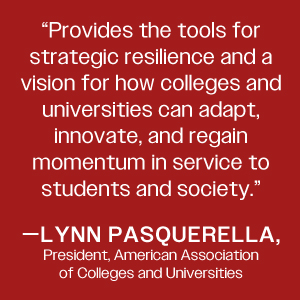
Most importantly, he insists that decline is not destiny. Peak, after all, can also mean peak performance—a higher level of institutional creativity and impact developed in response to constraint. Higher education faces a moment of extraordinary uncertainty. Every president, provost, board member, faculty leader, policymaker, and philanthropist is grappling with questions that have no historical precedent. Peak Higher Ed meets this moment by offering a big-picture map of how we arrived at this inflection point and a toolkit of adaptive strategies for forging a path forward.

Login to View & Leave Comments
Meet the Cats of Hopkins Press: The Purr-fect Companions to a New History of Cats
Cats through history—and around the Hopkins Press office.


Johns Hopkins University Press and BioOne Announce Landmark Nonprofit Integration
Baltimore, MD, and Washington, DC, USA, May 5, 2026—Johns Hopkins University Press (Hopkins Press) and BioOne today announced their merger, in a bold move designed to enhance community impact, expand future opportunities, and transform how they engage with...

Login to View & Leave Comments